A program that creates the environment for children to acquire English,
not just materials that teach it.
Palkids is not a set of separate “materials” for teaching vocabulary, pronunciation, grammar, reading comprehension, or conversation.
Instead, it is a complete “program” designed to immerse children in a large amount of spoken English and language input—much like the way children acquire Japanese or international students acquire English—so that the child’s brain can learn and absorb English through statistical and inductive learning.
Play it like background music during everyday life, and steadily build time with the sounds of English.
Gradually connect the English children hear to meaning and written words.
Build reading on top of an audio foundation and develop the English ability needed for Eiken Pre-2 and beyond.
What Is Palkids?
Palkids is a program designed to help infants, preschoolers, and elementary school children acquire English at home as a language they can actually use.
To develop usable English, children need comprehensive ability: listening, reading, understanding English in English, rich vocabulary, grammar, speaking, and writing.
Palkids is not a set of materials that develops each of these skills separately. It is a program that creates a home environment where young children can fully use their natural language-learning ability and build total English proficiency.
What Palkids Aims For
Rather than trying to teach the limitless body of English knowledge through many separate methods, Palkids aims to bring out children’s natural human ability and build, at home, the mental circuitry that processes English directly in English.
Why Don’t We Teach English Directly?
At Palkids, we do not use the commonly practiced approach of teaching grammar, explaining English through Japanese translation, or giving pronunciation instruction.
To acquire English, children need at minimum:
・speech perception formation to hear phonemes correctly,
・knowledge of phoneme pattern rules that differ from Japanese,
・the ability of segmentation to pull words out of sentences,
・a mental lexicon that builds word meaning,
・and the construction of grammar.
It is not realistic to teach these one by one explicitly. And no matter how much you teach or explain, knowing them as knowledge is not the same as actually being able to use them.
→ Read “The One and Only Reason People Can’t Use English”
Children who use English beautifully—such as returnees and international students—acquire it through a different learning process.
The human brain is naturally equipped to learn language through large amounts of data via “statistical inductive learning”. That is how newborn children acquire Japanese, and how international students acquire English.
Palkids is a program designed to switch on a child’s statistical inductive learning through the simple daily practice of playing English audio in the background. It may look indirect at first, but Palkids recreates at home the same learning mechanism people use when they naturally acquire a first or second language.
→ Read “How Do Children Acquire Language?”The Basics Are Background Audio and Online Lessons
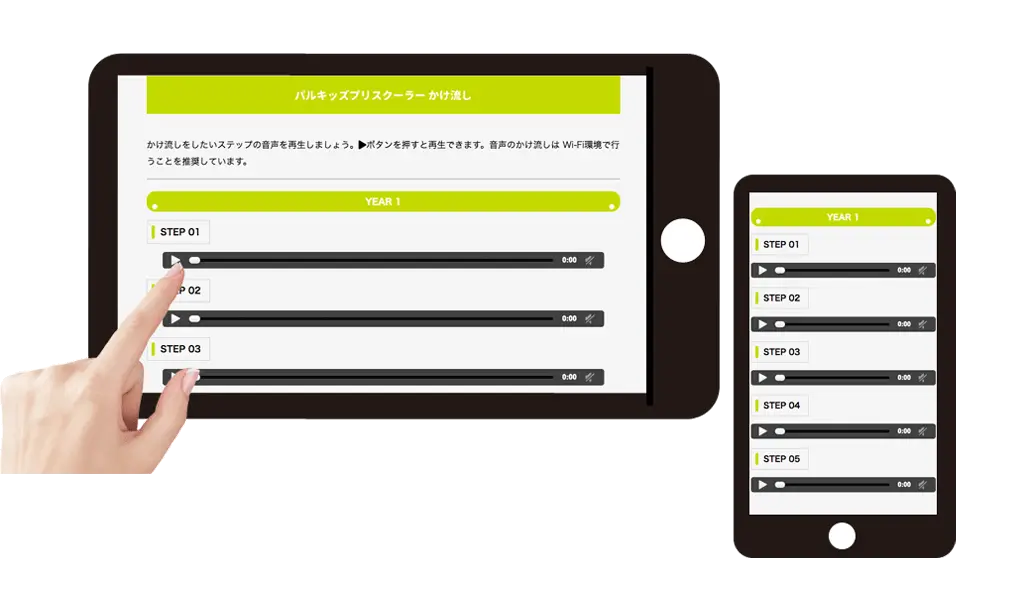
The core Palkids routine is extremely simple: playing English audio in the background and spending just a few minutes on online lessons. Background audio is not something children need to sit down and concentrate on. It can simply play like BGM during everyday life—while they play, eat, or get dressed.
If children listen for 90 minutes a day for two years, they can accumulate about 1,000 hours of exposure to spoken English. That is equivalent to the amount of contact with English during a three-month study-abroad stay. The online lessons are not designed to teach the structure of English either. They are short activities that help connect the English children hear to meaning and written words through looking, listening, and tapping.
In Palkids, the parent’s role is not to teach English, but to set up the English environment.
Play English in the background
Children do not need to listen with intense focus. Just let it play every day like background music in daily life.
Online lessons
For a few minutes a day, children connect sound, meaning, and print by watching and interacting. Parents can join in too.
Parents create the environment
The parent’s role is not to teach English, but to make it possible to continue the routine every day.
The Abilities Palkids Develops
The first abilities Palkids develops are the ability to accurately perceive English sounds, the ability to segment continuous speech into words, and the ability to build meaning from words and sentences. English has vowels, consonants, rhythms, and also rules for sound change such as linking, reduction, and elision. To understand English directly in English, children need everyday exposure to these features and a strong foundation for processing spoken English.
Once that foundation is in place, English is no longer just a stream of sound. In Palkids, this spoken-language understanding becomes the base for learning sound-to-print correspondence, helping children move from “English they can understand by listening” to “English they can understand by reading.”
→ Read “Is 1,000 Hours the Key to Learning English?—Why Some Children Acquire It in Four Months While Others Still Struggle After Ten Years”Toward Study-Abroad-Level Audio Experience in 4 Years
International students are exposed to large amounts of spoken English in daily life abroad. Even if they do not understand it at first, after one to two years—roughly 1,000 hours spent in an English environment—they develop the ability to process English without translating it into Japanese. As they continue to live in a rich English environment, the brain’s unconscious discovery of English patterns advances through statistical inductive learning, making study-abroad-level speech perception possible.
Living in Japan, it is not realistic to surround a child with English for 10 hours a day like an international student. Palkids works by building as little as 90 minutes of background English audio into daily life, gradually bringing children closer to study-abroad-level English audio experience over 2 to 4 years.
Estimate based on continuing 90 minutes of background audio every day. 365 days × 90 minutes ÷ 60 ≒ 547 hours/year
From English They Understand by Listening to English They Understand by Reading
The Palkids approach does not end with simply playing English audio in the background. On top of the listening ability built through daily input, children also work with picture books, phonics, and reading materials so that the English they already know by ear becomes connected to print.
For children who already know English as sound, written words are not completely unfamiliar symbols. Because spellings connect to words and expressions they already know by ear, it becomes easier for them to expand understanding from sound to print, and from print to meaning. This combination of listening ability and reading ability becomes the foundation for future Eiken success and for English study in junior high school and beyond.

Background-audio stage (understanding by listening)
- Children build a foundation for processing spoken English
- They begin recognizing words and phrases directly in English
- They become able to grasp content through listening
- They acquire vocabulary and sentence patterns through sound
Reading stage (understanding by reading)
- Children connect words they know by ear to written forms
- They read English in chunks and understand the content
- They can confirm word forms and meanings that were still vague through audio alone
- They grow into the kind of ability needed for Eiken and reading sections on entrance exams
From Eiken Grade 5 to Pre-2—and Onward Toward Pre-1
Palkids develops the ability to listen to English and understand it directly in English, as well as the ability to read English independently and understand its content. We use Eiken as one objective benchmark for checking that growth.
As Eiken levels rise, children need more than vocabulary and grammar knowledge. They must be able to listen quickly and accurately, read efficiently, and understand what they hear and read. Children who have had enough English audio exposure from early childhood and have built reading on top of that foundation can demonstrate the English they already possess in an Eiken format.
At Palkids, the near-term goal during the elementary school years is Eiken Pre-2. Once speech perception and reading ability are in place, some learners progress from Grade 5 to Grade 4, Grade 3, and Pre-2 within just one to two years. After that, continuing their studies at school and at home makes it realistic to advance to Grade 2 and Pre-1.
How to Start by Age
Palkids offers materials matched to a child’s age and English experience.
Palkids Preschooler
Ideal for families creating an English environment for the first time. Over two years, it builds a foundation in listening.
Learn morePalkids Kinder
Continues the English audio environment for another two years and increases the amount of English children can understand.
Learn morePalkids Junior
Builds the skills that lead to reading and Eiken, based on a child’s age and English experience.
Learn moreWe also offer the 96-book picture-book set “I Can Read,” which further strengthens the English environment that supports speech perception while building vocabulary, comprehension, and reading ability. We recommend adding it early to create a smooth path toward reading comprehension.
How Palkids Differs from Typical Home English
In a broad sense, Palkids is one form of home English. The major difference is that instead of teaching the many individual skills needed for practical English one by one, it aims to help children acquire them comprehensively through statistical inductive learning.
The golden window for foreign-language acquisition in early childhood and the elementary years is limited. That is why Palkids systematizes the time, content, and sequence of English input, and is programmed so families can move efficiently and easily from online lessons to picture books and reading at home.
For more on home English and Palkids, please see “Home English and Palkids”.
Typical home English
- Each family chooses its own materials and methods
- The amount and difficulty of input can vary easily
- Results are more likely to depend on the parent’s English ability and information gathering
- The path to reading and Eiken is left to each household
Palkids
- Daily input time and content are systematized
- It connects all the way through online lessons and reading
- Designed so families can continue every day without depending on the parent’s English ability
- Covers the path through Eiken preparation within one program
Palkids Recreates an English Environment at Home

Palkids is a program that recreates at home the environment needed for English acquisition without relying on international schools, study abroad, or direct English instruction from teachers or parents. It does this by combining daily audio input, short online lessons, picture books, reading materials, and Eiken preparation.
The basic idea behind Palkids is to create an environment where children can grow into learners who listen to English, understand it, read it, and eventually learn on their own.
Instead of teaching English,
create the environment where it grows.
That is the core philosophy of Palkids.
Frequently Asked Questions
What is Palkids?
Palkids is a program that helps infants, preschoolers, and elementary school children acquire English at home as a real working language. Through daily background English audio and online lessons, it creates an English sound environment in the home and develops speech perception and vocabulary.
Is Palkids a form of home English?
Yes. In the sense that it creates an English environment at home, Palkids is one form of home English. However, instead of leaving families to figure everything out through trial and error, it systematizes the full path from English input to lessons to reading.
Can we do it even if the parent does not speak English?
Yes. In Palkids, parents do not need to teach English or speak to their child in English. Their role is to create an environment where daily background audio and online lessons can happen consistently.
Is Palkids a conversation textbook?
Palkids is not a program aimed only at English conversation. Its focus is on first creating a strong English audio environment, then developing the ability to hear English and understand it directly in English, and from there connecting that ability to reading.
Can children really acquire English just from background audio?
Background audio is an important entry point for giving children regular exposure to spoken English. But Palkids does not stop there. Through online lessons, picture books, and reading materials, it leads children from English they can understand by listening to English they can understand by reading, and then onward to Eiken.
At what age can children start Palkids?
Children can start from birth. Early childhood through the lower elementary years is an especially good time to create an English audio environment at home. Depending on age and English experience, families can choose materials such as Preschooler, Kinder, and I Can Read.
Does Palkids also lead to Eiken?
Yes. The near-term goal of Palkids is for children to achieve Eiken Pre-2 during the elementary school years. By first developing speech perception and then building reading on top of it, the program lays the foundation for moving from Eiken Grade 5 to Pre-2 and eventually to Pre-1.
Why is it beneficial to start in early childhood?
Early childhood is a time when it is easier to naturally incorporate English audio into daily life and to secure enough time for it. Because children can be exposed to English audio from about 90 minutes a day without interfering with Japanese development or other learning, it becomes easier to build speech perception naturally and sustainably.
What is statistical inductive learning?
It is the process by which children unconsciously learn the sounds of language, word order patterns, and chunks of meaning through repeated exposure. Palkids values giving children daily English audio so they can naturally learn the patterns and regularities of English on their own.