Home English and Palkids
Structuring English at Home into a Sustainable System
Palkids is a home English program designed as one continuous path—from audio immersion and online lessons to picture books, print, and reading comprehension—moving children from “understanding spoken English” to “understanding written English.”
In the sense that it creates an English environment at home, Palkids is one form of home English.
From audio immersion to lessons, picture books, and reading, everything is designed in advance as one connected learning flow.
It is built so children can continue as part of a daily routine without depending on a parent’s English ability.
The characteristics of home English and Palkids
Home English is a broad term for efforts to create an English-rich environment at home. Audio immersion, picture books, videos, apps, and online English conversation lessons can all be part of it, and the approach differs from family to family. For more details, see the “What Is Home English?” page.
Palkids is also one form of home English in that it creates an English environment at home. Its major distinction is that it is not a set of materials that teaches listening, grammar, vocabulary, pronunciation, phonics, reading comprehension, and writing one skill at a time. Instead, it is a program designed to develop the kind of integrated English ability children can use naturally, much like the way they use Japanese every day.
To build English children can actually use, Palkids arranges audio immersion, online lessons, picture books, reading aloud, reading comprehension, and even Eiken preparation into one connected sequence. By exposing children to English audio, linking sound with meaning, and then moving into print and comprehension, it develops the full range of abilities needed for home English.
📚Typical home English
- Each family chooses and combines its own methods
- What to do, in what order, and how much is left to each family to decide
- Audio immersion, picture books, and conversation practice are usually selected separately
- The stage-by-stage connection (sound → meaning → print) needs to be planned deliberately
✦Palkids
- Audio immersion, lessons, picture books, print, and reading are designed as one connected flow
- The amount and sequence are planned in advance
- Each element is designed to lead naturally to the next stage
- Children progress step by step from “understanding spoken English” to “understanding written English”
Palkids Is Also Home English
What sets Palkids apart is that it systematizes audio immersion, online lessons, picture books, print, reading comprehension, and Eiken preparation into one learning flow.
Palkids is designed around the stages of language development
Palkids begins with large amounts of audio input, much like the process young children go through when acquiring Japanese or international students experience when acquiring a new language. By creating time every day to hear English, children build the ability to perceive and process English sounds.
Then, through short online lessons, those sounds are connected with pictures, situations, and meaning. From there, what children already know by ear is linked to picture books and print, leading naturally into reading aloud and reading comprehension.
Audio immersion, online lessons, picture books, print, and reading comprehension are not separate activities. They are positioned as one connected flow that moves children from “understanding spoken English” to “understanding written English.”
lessons Connect sound and meaning in a short lesson
& print Link the English children hear to written language
comprehension & Eiken Measure and apply English ability
From speech perception formation to reading comprehension and Eiken
What Palkids values first is not memorizing English songs, words, or phrases, but building the foundation for hearing English as English.
English has vowels and consonants, rhythm, and intonation that differ from Japanese, as well as sound-change rules such as linking, reduction, and elision. The foundation that enables children to distinguish these English sounds and process them as connected sound units is called speech perception formation.
by ear
by reading
While children are exposed to English audio every day, online lessons and picture books connect those sounds to meaning. Then, by moving into print, reading aloud, and reading comprehension, “English they understand by ear” grows into “English they understand by reading.” Exams such as Eiken can be used to confirm progress in listening, vocabulary, and reading, while also giving children practice adapting to test formats.
Because parents don’t teach, families can keep going
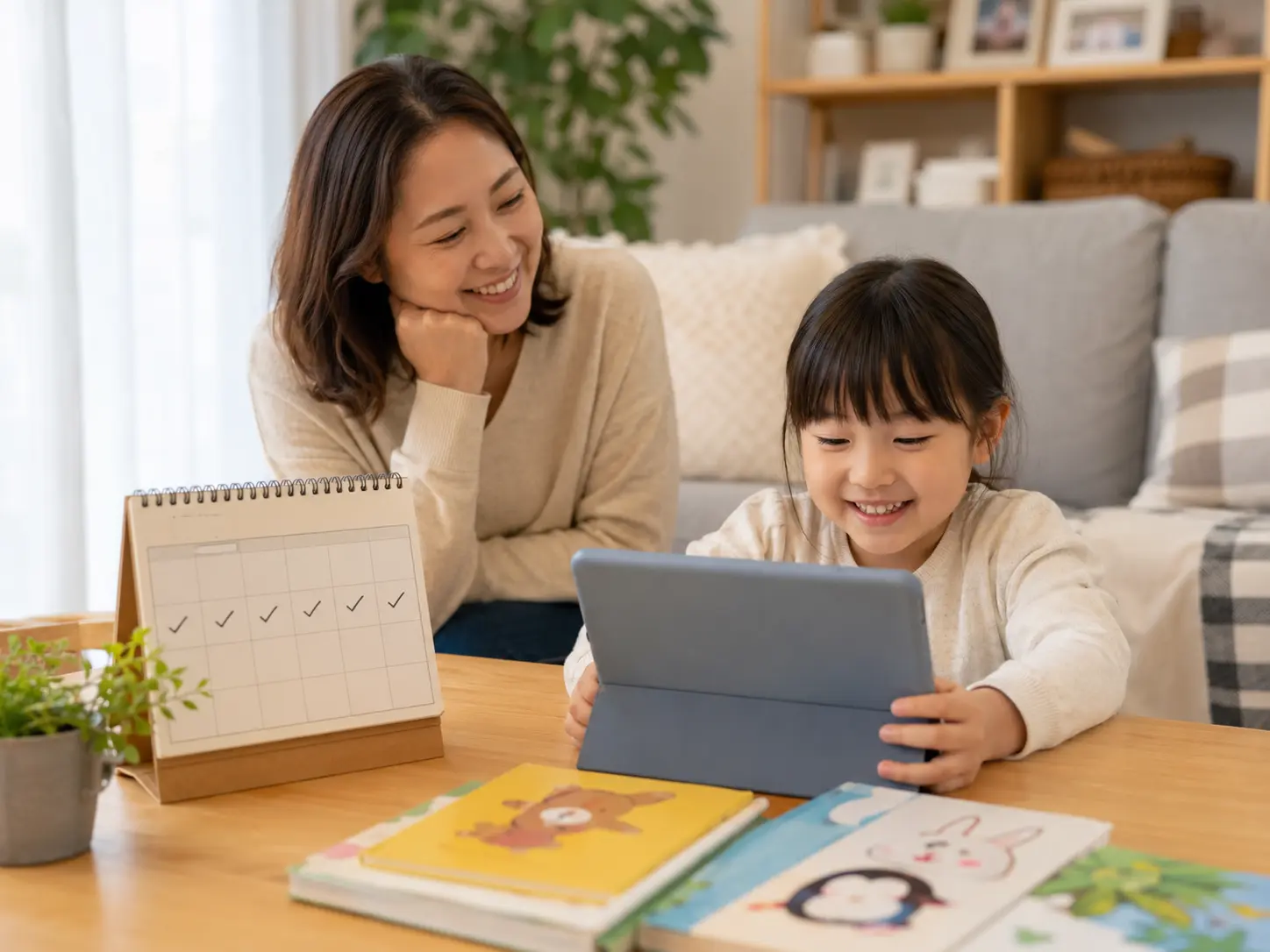
Some forms of home English involve parents speaking to children in English or reading picture books together.
Palkids does not assume that parents themselves will teach English. Parents do not need to speak English, and they do not need to explain pronunciation or grammar.
The parent’s main role is to create the environment and routine for daily English audio and brief online lessons. Because the core activities are designed to fit smoothly into everyday family life, children can continue being exposed to English without relying on a parent’s English ability.
Parents Don’t Teach English
It is not built on the assumption that parents will explain pronunciation or grammar. The audio and lessons provide the English model.
Set Up the Environment
The parent’s main role is to establish a daily habit of audio immersion and short lessons.
Follow the Learning Flow
Children progress along a step-by-step flow from sound to meaning, print, and reading comprehension.
Choosing the right kind of home English for children today
The best approach to home English cannot be determined by age alone. Even at the same age, the next English experience a child needs will differ depending on whether the child is almost completely new to English, can understand some spoken English, or can already read simple sentences.
When choosing materials or activities, look at a child’s age, previous English experience, and current stage of learning to decide what kind of English input or practice should come next.
→ How to choose home English materials based on age, English experience, and current stageFrequently Asked Questions
Is Palkids a form of home English?
Yes. In the sense that it creates an English environment at home, Palkids is one form of home English. Its defining feature is that it systematizes audio immersion, short online lessons, picture books, print, and reading comprehension as one connected learning flow.
What is the difference between home English and Palkids?
Home English is a broad term that refers to creating an English environment at home in general. Palkids is a home-use English program that organizes audio immersion, online lessons, picture books, print, and reading comprehension into one learning flow that connects listening skills to reading skills.
Do parents need to teach English in Palkids?
No. It does not assume that parents will teach pronunciation or grammar. The parent’s role is to create an environment where children can engage with daily English audio and short online lessons.
Which materials should we start with?
Think in terms of your child’s age, previous English experience, and current stage of learning. For more details, see the page on how to choose home English materials.